THE SHORT ANSWER
Before producing a co-branded mahjong collection, identify who controls each logo and artwork file, then record permission for the products, markets and uses you plan. Keep brand approval separate from production approval. An artwork file or retail reference does not, by itself, document a right to manufacture or sell the design.
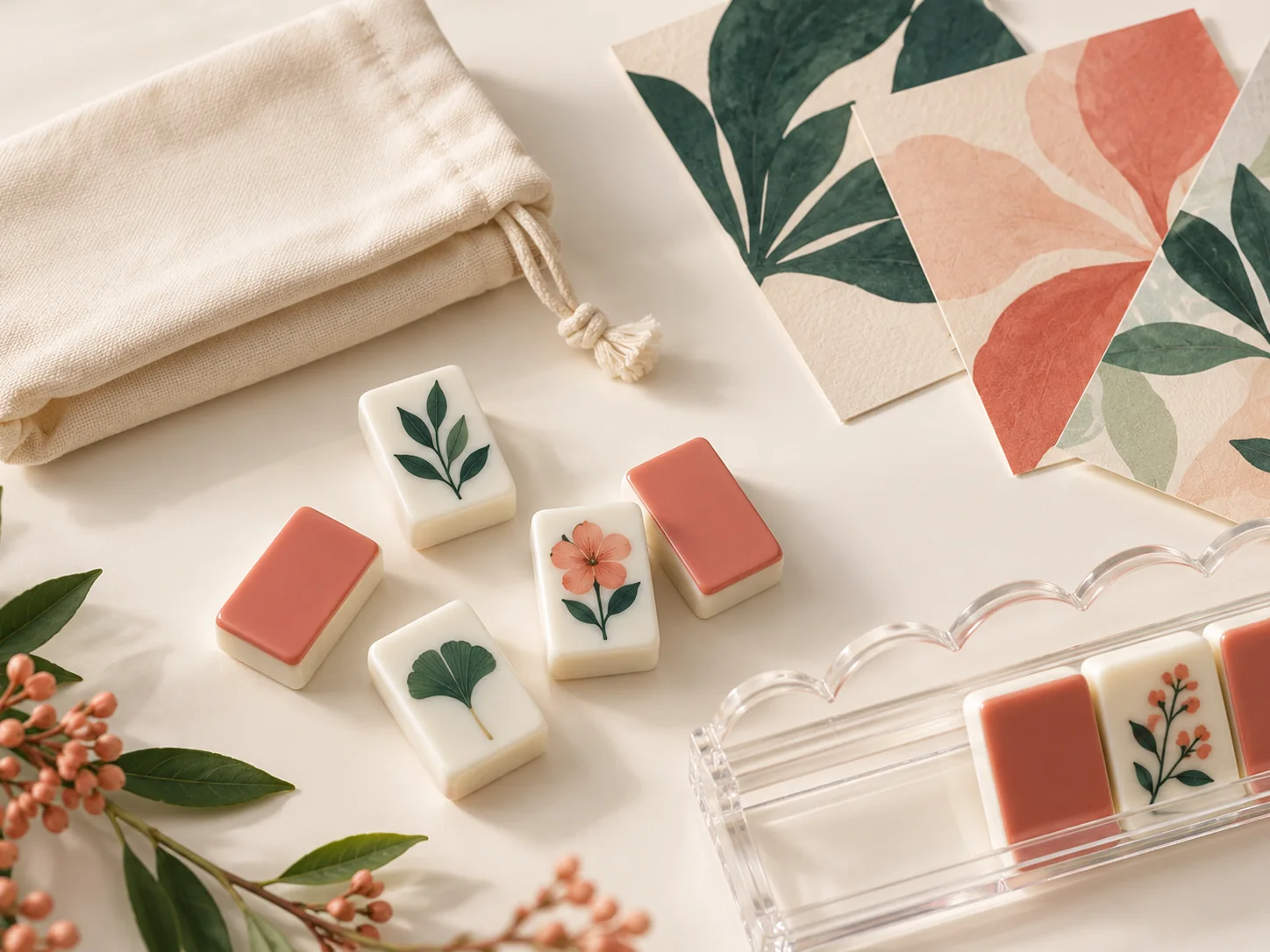
Coral-backed tiles beside a clear rack, a canvas pouch and botanical swatches. No partner brand or licensed collection is shown.
Why a retail collaboration is a useful question source
LoveShackFancy’s brand-owned collaboration listing includes an Oh My Mahjong collection. It provides a concrete example of a fashion identity appearing across mahjong products. That single listing does not establish industry-wide demand, reveal the partners’ licensing terms, or show that another supplier may reproduce the collection.
For an independent brand or event buyer, the useful question is narrower: if another organisation’s name or an artist’s work is part of your brief, which permissions should be resolved before files move into manufacturing?
Whose permission do I need for a logo and a pattern?
Start by separating the assets. The U.S. Patent and Trademark Office (USPTO) explains that a trademark identifies the source of goods or services; a brand name or logo can perform that function. Copyright protects original artistic or literary work. A decorative pattern and a brand identifier therefore raise different questions, even when they appear in the same design file.
The U.S. Copyright Office recommends identifying the current rights owner and obtaining permission where needed. The person who sends a file may be a designer or agent rather than the person able to authorise every intended use. Ask them to identify the owner and their authority.
Sources: USPTO — What is a trademark?USPTO — Trademark process: choosing the right type of protectionU.S. Copyright Office — How to Obtain Permission, Circular 16A
What should our written rights brief cover?
Use the following as a discussion record with the owner or their authorised representative. It is a proposed buying checklist, not a statement that every licence must use one format or that the listed permissions have already been granted.
| Decision | Record before handover | Mahjong-specific question |
|---|---|---|
| Exact asset | Owner, file name and revision | Does approval cover the tile-back artwork as well as the logo? |
| Product coverage | Each authorised product category | Are mats, pouches and outer boxes included or only tiles? |
| Market and channel | Territory and permitted sales channels | Does the agreement cover wholesale, club sales and online retail? |
| Permitted changes | Who can resize, recolour or adapt files | May a wide mat pattern be rearranged for a small tile back? |
| Manufacturing access | Approved production parties and handling instructions | Can the selected factory receive and reproduce the files for this order? |
| Time and repeat orders | Term, renewal and remaining-stock instructions | What happens when the event ends or a reorder is requested? |
| Public presentation | Brand guidelines and approval responsibility | Who signs off the product listing and launch imagery? |
Can a sample approval double as brand approval?
Treat these as separate decisions in your project record. The rights owner may need to review a logo’s placement or an adapted pattern. The buyer also needs to review the physical product. Record who can approve each decision and which file version they accepted. A good-looking physical sample does not fill an unanswered permission field.
For a UK trade mark, government guidance describes a licence as an agreement with the owner, with terms such as duration and cost agreed between the parties. That does not establish the scope of a U.S. or worldwide arrangement. Confirm the applicable markets and seek appropriate advice when the ownership or licence scope is unclear.
What should go to the factory, and what should stay restricted?
Send the approved production files, a clear revision list and the instructions the factory needs to follow. Keep commercially sensitive licensing terms within the parties that need them; provide the relevant authorisation and production scope without circulating an unrelated contract in a public brief.
Before a repeat order, check whether the same owner, assets, products, territory and term still apply. If something changed, pause the affected use until it is resolved. This is a document-control recommendation, not a promise that the factory provides rights clearance or legal services.
Buyer questions
These answers organise an initial rights discussion. They do not grant permission or replace a review of your agreement.
Can I send another brand’s collection as a design reference?
Identify what you are referencing and keep it separate from the files proposed for reproduction. A reference is not proof of permission to copy a protected design.
Does buying artwork give me every manufacturing right?
Check the actual agreement. Record the allowed products and uses rather than assuming that payment covers all adaptations, markets and repeat orders.
Does a tile licence automatically cover mats and bags?
Confirm each category in writing. Do not infer accessory permission from approval of one tile design.
Can the factory change a partner’s logo to fit?
Resolve the permitted changes and approval owner before production. Return any proposed change to the authorised decision maker.
What should I include in the first inquiry?
Include the product categories, quantities, destination markets, artwork status, relevant authorisation scope and the people responsible for brand and physical-sample approvals.
KEEP THIS CHECKLIST
- List every logo, pattern and file owner
- Resolve product, market, channel and term
- Confirm allowed changes and production access
- Separate brand approval from physical approval
- Recheck permission before repeat orders
Sources & context
- U.S. Copyright Office — How to Obtain Permission, Circular 16AOfficial guidance; revised March 2021 · Accessed 2026-10-26
- USPTO — What is a trademark?U.S. trademark guidance; brand identifiers · Accessed 2026-10-26
- USPTO — Trademark process: choosing the right type of protectionU.S. official guidance; trademarks and copyright protect different interests · Accessed 2026-10-26
- UK Government — Using somebody else’s trade markUK guidance; licensing terms are agreed with the owner · Accessed 2026-10-26
- LoveShackFancy — Collaboration collectionBrand-owned retail listing; one collaboration, no market-wide demand evidence · Accessed 2026-10-26
The rights brief below is a purchasing workflow, not a licence agreement or a finding that any design is cleared. Applicable rights and contract terms need review for the intended markets. Editorial policy.