THE SHORT ANSWER
Choose a tote to carry the collection, a tile pouch to contain loose tiles and a rack roll to separate long racks. Approve storage with the actual loaded components, rather than relying on external dimensions or an empty-bag photo.
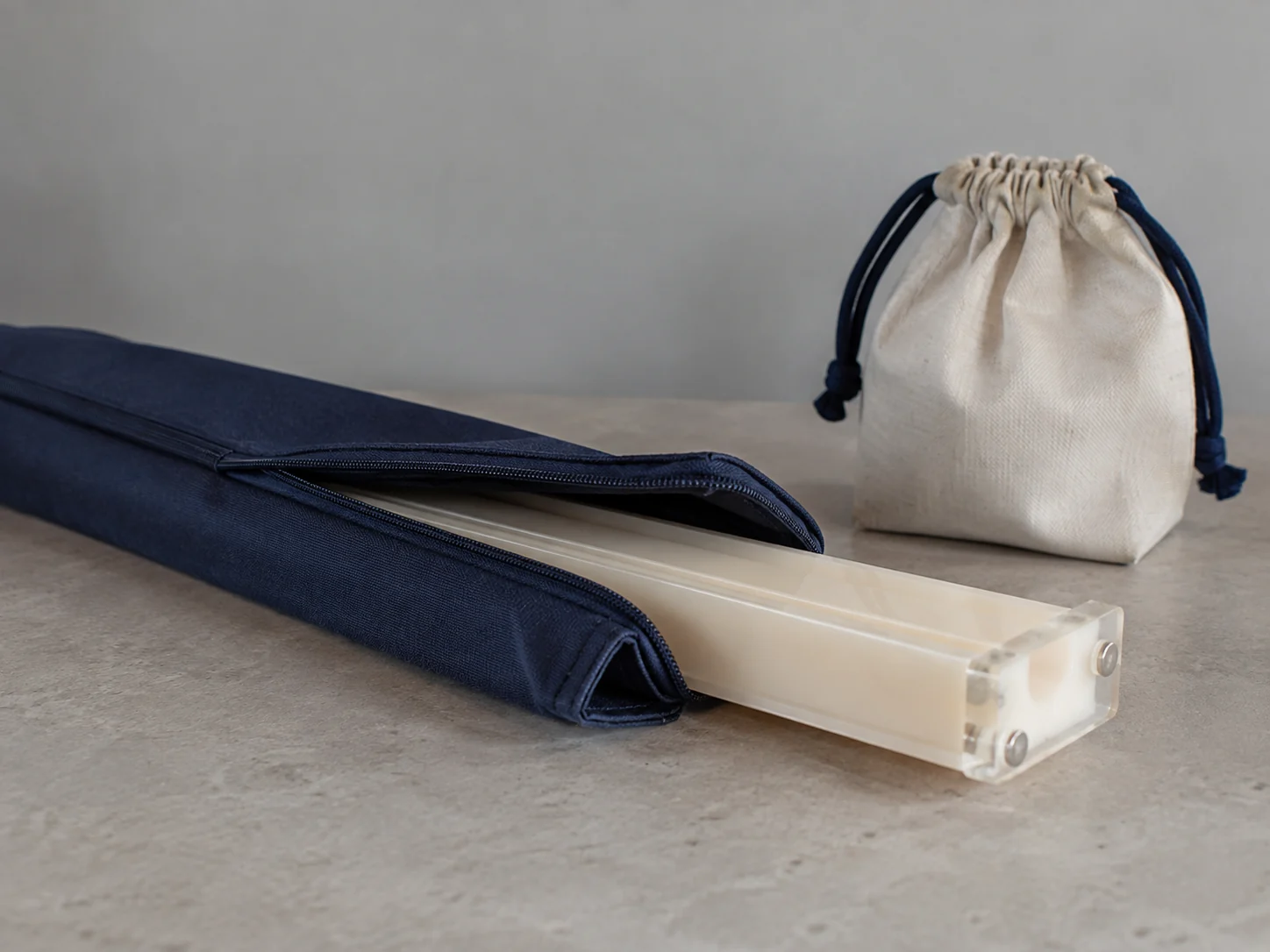
AI-assisted illustrative scene; not an inventory diagram or a customer endorsement. Finished specifications require sample approval.
- 01List contents
- 02Choose carry format
- 03Test loaded fit
- 04Approve closures
Start with the journey
A bag for moving between rooms has a different job from a bag used for weekly travel. List what the customer carries: tiles, extras, four racks, a mat, chips, dice and the booklet. Decide whether the items should travel in one outer bag or separate modules. This is a product-planning recommendation, not a measured preference shared by all players. The correct choice depends on the brand’s intended customer and the weight of the proposed kit.
The carrying tote: one outer home
A rectangular tote offers handles and a main compartment for moving the collection. Internal pouches can keep hard components apart, but the fully loaded set needs to be checked. Inspect handle attachment, clearance around the zipper and whether a rack presses against the side wall. Publish the agreed usable dimensions rather than assuming every American mahjong set is the same size. Our tote direction supports color customization on the chosen format.
The tile pouch: a separate module
A long tile pouch is useful when the tiles need their own compartment. A transparent section makes the contents visible, while the opening and usable volume determine how easily a complete set can be packed. Check the chosen playing inventory and all extra tiles together. The factory should confirm the material and closure in the physical sample; a generated product illustration cannot establish abrasion resistance, strength or the final carrying capacity.
The rack roll: protect long components
The roll-up format separates racks into individual pockets and wraps around them. It is a rack-storage product, not a playing mat. Test the actual rack length, height and any attached pushers in the pockets before approving the roll. A rack advertised by its outer length may still have a different profile or extra projection. Closing the roll should not force the rack edges into seams or prevent the straps from fastening comfortably.
Order storage as part of the system
The linked YMI product page explicitly asks buyers to check measurements before pairing tiles with existing accessories. The same principle applies when developing a new storage range. Make a contents list and fit record, then review the bag with the racks, tiles and any additional components. For our range, accessories support custom colors; extra structural or branding changes should be assessed separately rather than assumed included in that offer.
Test the bag as it will be carried
Load the actual kit and check closure, removal and repacking. A bag can appear roomy in a catalog photograph while becoming awkward when the mat or rack is added. Record usable internal dimensions and the specific contents reviewed. If the range includes several tile profiles, identify which one controls the sample.
For a retailer, a packed photograph helps communicate what fits, but it should not imply that pictured accessories are included when they are sold separately. Pair the photograph with a precise contents statement.
Choose the customization route
Ask about available styles when you want a starting point, or send your own design, reference image or sample for review. Custom colors and logos are supported. Confirm the proposed fabric, lining and details rather than assuming all styles share the same construction.
A matching rack roll and tote can form a coordinated range, but each piece still needs its own fit check. Keep the approved dimensions and logo placement with the order record. This makes later inquiries about additional accessories more specific and reduces the risk of an incompatible reorder.
KEEP THIS CHECKLIST
- List the complete carried inventory
- Distinguish tote, tile pouch and rack roll
- Measure the actual racks and tiles
- Review closures with the bag fully loaded
- Approve accessory colors on physical materials
Sources & context
- Factory ordering scope: MOQ, customization, samples and shippingFactory terms confirmed by the owner on 10 September 2026 · Accessed 2026-09-11
- Reddit: Tiles are big — cannot find rack sizePlayer discussion · Accessed 2026-09-11
- Yellow Mountain Imports: Koi tile dimensions and compatibility notePublished product specification; not this factory’s specification · Accessed 2026-09-11
Forum excerpts are qualitative feedback. Product specifications describe linked products only. Recommendations are editorial judgments, not lab results or statistical popularity rankings. Editorial policy.