THE SHORT ANSWER
Choose a hinged mahjong pusher when you want the arm to stay with each rack between sessions. Choose a separate pusher when easy replacement matters and you have a reliable way to count loose pieces. Consider a magnetic attachment when detachable storage solves a real problem and the exact mating parts, retention and applicable safety evidence can be reviewed before ordering.
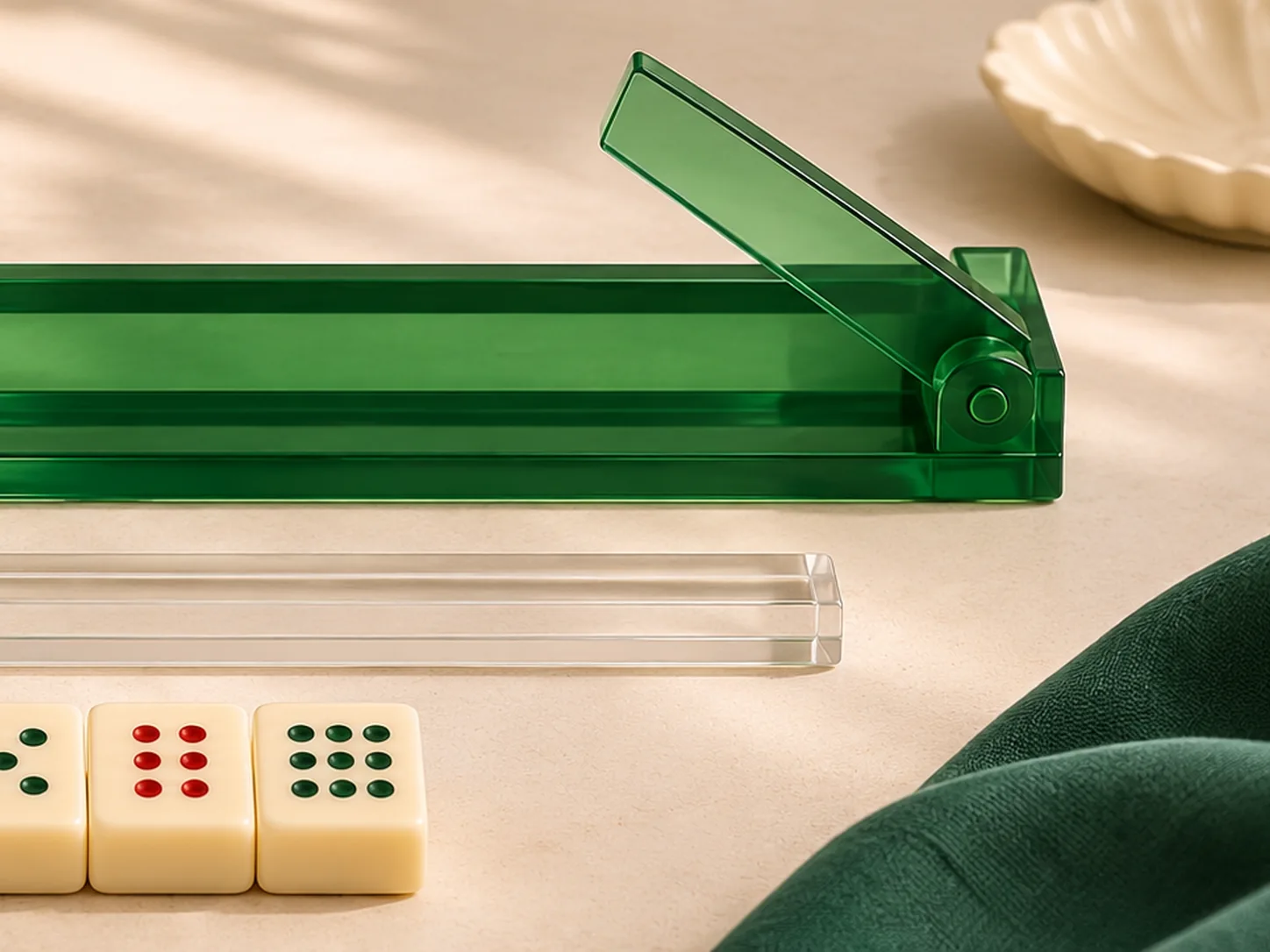
A hinged rack and a separate straight pusher beside a partial row of tiles.
Identify how the pusher connects
A pusher moves a built tile wall toward the middle of the table. A hinged arm pivots on the rack. A separate rail can be moved by hand without a connection. A magnetic pusher uses a magnetic attachment to mate with a compatible rack or fitting. Ask for the assembled and packed configurations. A photo of a pusher beside a rack can leave the actual connection unclear. The Mahjong Line lists one stackable model with a magnetic arm. Its product listing establishes that the format is offered, while performance depends on the sample you assess.
Compare the work each design adds
Run all three configurations with the same tiles, table, mat and operators where possible. Judge setup, wall movement and pack-down together. The fastest configuration to put away may be the one that takes more work to replenish. Record whether the arm can be operated with one hand while the other steadies the rack. Try each approach from both ends if the design can be reversed. Check what happens when the wall meets the edge of the mat or when players leave different gaps between adjacent racks. Keep these trial observations with the configuration, since a different tile depth or a new arm revision can change the result.
| Decision | Magnetic attachment | Hinged arm | Separate rail |
|---|---|---|---|
| Setup | Match and attach the arm to the correct rack | Swing the arm into position | Take a rail from storage and position it by hand |
| Wall movement | Check hold and alignment during a normal push | Check the arm path, stop and clearances | Check that the loose rail contacts the wall evenly |
| Pack-down | Define where each detached arm sits | Fold the arm into its packed position | Assign a counted space for loose rails |
| Replacement | Match the exact fitting and revision | Check whether the arm can be serviced or the rack needs replacement | Confirm spare dimensions and working edge |
| Wear review | Inspect attachment seats and any exposed or loosened parts | Inspect the joint, fastener and play in the arm | Inspect edges, straightness and deformation |
| Evidence before release | Confirm how any magnet is retained and who assesses the safety scope | Document the joint and packed clearances | Document the loose-part count and approved rail specification |
Match the mechanism to your tables
For a club with several tables and shared storage, try a full reset with the people who actually pack the equipment. A hinged arm can reduce the number of separate pieces to count. Check that folded arms fit the storage bag and that nearby racks do not press on the joints. When spare rails can be stored and counted easily, a separate pusher offers a simpler replacement path.
For a retail set, run an unassisted unpack-and-setup check with the proposed instructions. If the magnetic arm has one correct orientation, show it clearly. When a set uses color-matched or differently sized racks, record the compatible pusher revision next to the rack SKU so a later replacement can be specified correctly.
Review the magnetic assembly separately
On November 5, 2026, the U.S. Consumer Product Safety Commission announced a recall of Magnetopia building cubes that could release magnets if they broke or opened. The recall covers those toys. For a mahjong pusher, the practical question is whether foreseeable handling can free a magnet or a small component containing one. Ask for the attachment drawing, the exact sample revision and the assessment for the intended market. A magnet that feels secure on arrival gives no test result.
CPSC guidance distinguishes the U.S. magnet rule in 16 CFR part 1262 from toys covered by part 1250. Have the responsible importer determine the applicable scope and evidence for the actual product and its intended use. Ask an appropriate testing provider what evaluation applies before agreeing to a magnet configuration.
Sources: CPSC — Magnetopia building cubes and blocks recallCPSC — Magnets FAQs
Request the correct rack and pack-out
Our published rack range uses acrylic and includes U-shaped and flat-base pusher options. The listed outer lengths are 445 mm and 508 mm. Depending on the variant, the purchasing unit may be a single or a four-piece pack. Give us your tile dimensions, playing surface, mechanism preference, requested pack count and destination. Confirm the actual pusher geometry, attachment and replacement route in writing for the selected configuration. The published shapes alone do not establish how the pusher attaches.
Buyer questions
Use the actual rack, tiles and packaging to close these questions.
Can I swap magnetic arms across rack models?
Treat interchangeability as a sample check. Confirm the fitting, alignment, working edge and compatible revision with the supplier.
What should a club count after play?
Count racks and every separate rail or detachable arm per table. Include spares as a separate storage line.
Does a hinged arm always pack smaller?
Packed size depends on the folded profile, the way racks stack and the space required to protect joints. Measure the proposed packed set.
Can I assess magnetic safety by pulling on the arm?
A pull by hand may reveal an immediate fit issue. The applicable safety review depends on the design, its use and the evidence for that configuration.
What should I send to compare two samples?
Send actual tile dimensions, the mat and table setup, intended users, destination, pack count and the two exact rack and pusher revisions.
Prepare a rack brief
Specify how the pusher should attach, move the wall, fit the pack and be replaced. Include the intended market if the assembly contains magnets.
KEEP THIS CHECKLIST
- Run the same wall movement with each exact pusher and rack
- Record the setup and pack-down sequence
- Confirm spare compatibility and pack count
- Identify any magnets and the responsible safety reviewer
- Approve the configuration and replacement revision together
Sources & context
- The Mahjong Line — stackable rack and pusher setBrand listing for one magnetic pusher configuration. No comparative test or launch date used. · Accessed 2026-11-09
- CPSC — Magnetopia building cubes and blocks recallU.S. recall 27-076, announced November 5, 2026. Concerns building toys. · Accessed 2026-11-09
- CPSC — Magnets FAQsU.S. regulator guidance on magnet product scope and separable components · Accessed 2026-11-09
The comparison applies to rack-mounted or separate wall pushers for American mahjong. It gives proposed sample checks. Product availability, test scope and results depend on the exact configuration. Editorial policy.