THE SHORT ANSWER
A mahjong collection’s intended audience must be assessed from the whole product and its marketing. A label alone cannot establish that it is an adult product. Before ordering for the United States, document who will use it and ask the responsible importer to identify the applicable rules and evidence for that exact collection.
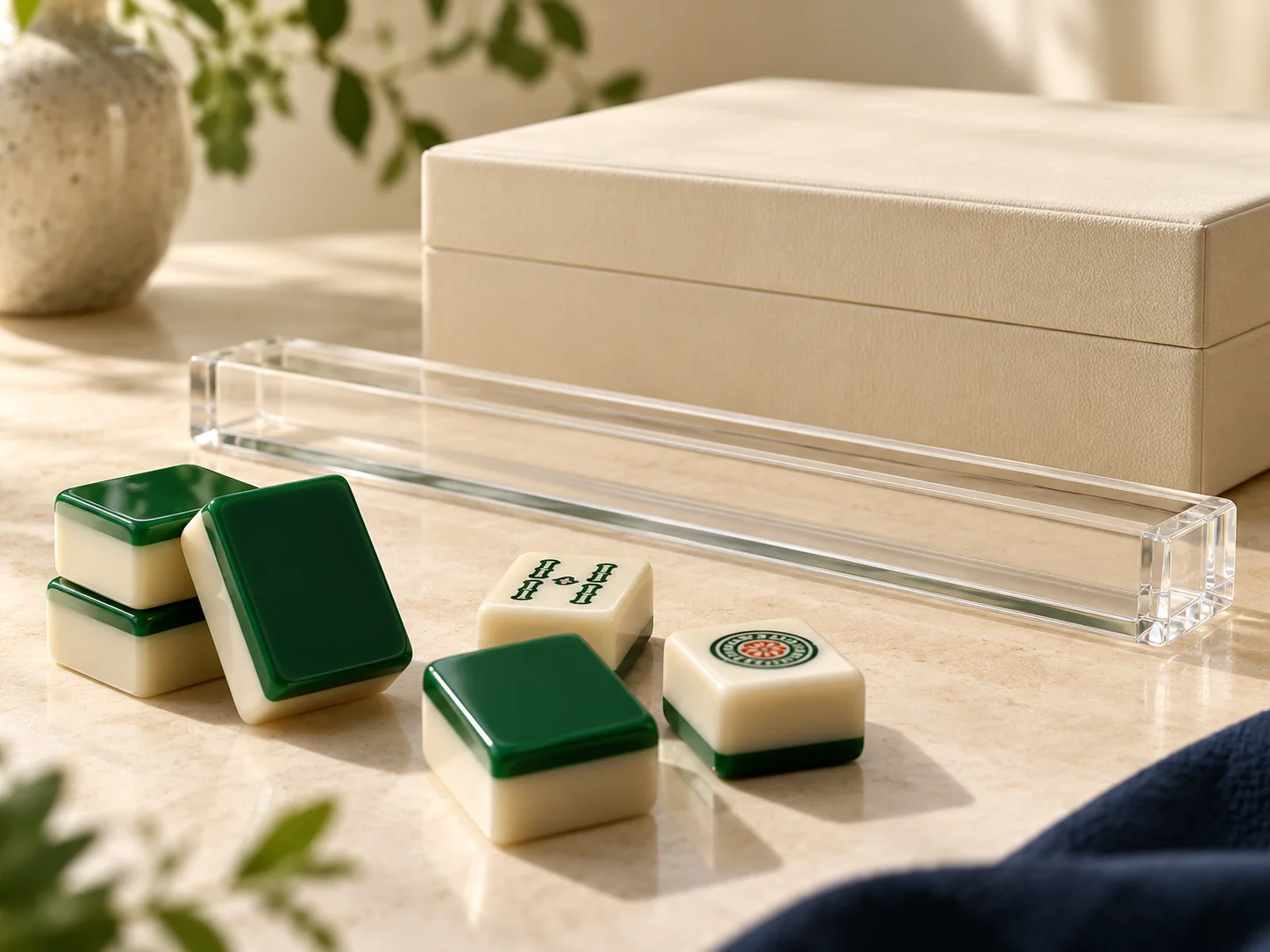
Green-backed tiles, a clear rack and a closed box. The arrangement does not establish an age classification or safety result.
Why audience positioning belongs in the buying brief
The U.S. Consumer Product Safety Commission (CPSC) defines a children’s product by whether it is designed or intended primarily for children aged 12 or younger. Its guidance considers the manufacturer’s reasonable statement, packaging and promotion, common consumer recognition, and age-determination guidance together. An adult club collection and a collection promoted for children’s lessons therefore need separate assessments, even if they share a tile shape.
On October 20, 2026, CPSC posted an upcoming October 30 meeting with international-mail brokers about the Entry Type 13 mail-entry process and electronic filing of certificate data (eFiling). That announcement is a reason to resolve classification before shipment; it is not a new rule declaring all tabletop games to be children’s products.
Sources: CPSC — Children’s ProductsCPSC — International mail broker meeting, posted October 20, 2026
The age boundary is more specific than “not for children”
An intended-age statement must fit the expected use. Under 16 CFR 1200.2, writing an older age on a label does not override other evidence that the product primarily appeals to younger children. The determination is specific to the product, rather than a blanket ruling for every item called mahjong.
Toy scope and children’s-product certification also have different age boundaries. CPSC’s toy guidance explains that ASTM F963 addresses toys for children under 14, while the children’s-product testing and certification requirements concern products intended primarily for ages 12 and younger. A 13+ label is therefore not a universal exemption from toy requirements.
Sources: 16 CFR 1200.2 — Definition of children’s productCPSC — Toy Safety Business Guidance
Build an audience record that the importer can review
Prepare this record before approving packaging text. Keep actual launch copy and artwork versions with it, so a later change to the audience does not get lost between the brand, designer and importer.
| Brief item | What the buyer should supply | Question to resolve |
|---|---|---|
| Primary players | Adult club, general-use audience, or children’s programme | Who is the collection primarily designed for? |
| Sales presentation | Retail description, packaging and planned advertising | Does the presentation match the intended audience? |
| Product configuration | Tiles and all included racks, bags, chips or other items | Which components need assessment in the finished collection? |
| Destination and roles | U.S. importer and intended sales channel | Who makes the classification and certificate decisions? |
| Evidence status | Documents linked to the selected model and revision | What exists, and what still needs to be obtained? |
Ask for the right evidence, rather than a generic certificate
CPSC’s Children’s Product Certificate (CPC) guidance explains that applicable children’s products require certification based on the relevant evidence, including testing by a CPSC-accepted third-party laboratory where required. The certificate must identify the covered product and applicable rules. A report for a different construction is not a useful substitute for checking the collection you will import.
For general-use products, a General Certificate of Conformity is required only where an applicable CPSC rule requires certification. Adult positioning does not by itself answer that rule-by-rule question. Ask the importer to document the basis for both required and non-required items.
Sources: CPSC — Children’s Product CertificateCPSC — General Certificate of Conformity
Keep audience review separate from fit and sample approval
For your supplier inquiry, identify the intended audience, destination, exact contents and any documents requested by the importer. Ask which material, decoration and component records can be provided for the selected configuration. Do not use an attractive product image or a successful fit check as evidence of chemical or regulatory compliance.
This preparation method is useful for brands and clubs deciding how to describe a collection. It cannot assign a final age grade, prescribe every required warning or extend a U.S. conclusion to another market. If packaging, included accessories or promotional imagery changes, return those changes to the person responsible for the assessment.
Buyer questions
Use these questions to organise the discussion with your importer and product-safety adviser. Their assessment needs the actual product and planned presentation.
Does “14+” on the box settle the classification?
No. An age label is one factor. The product and the way it is presented must support that positioning.
Is a set used at an adult club automatically outside every safety rule?
No. General-use products may still be subject to applicable requirements. Ask the importer which rules apply to the finished collection.
Do CPC and GCC mean the same thing?
No. A CPC concerns applicable children’s products; a GCC concerns certain regulated general-use products. The correct route depends on the product and rules.
Does ordering a small quantity replace the evidence review?
Do not use the order quantity as your classification decision. Ask which requirements and any valid exceptions apply to your product and business.
What should I send with a mahjong inquiry?
Send the destination, primary audience, product contents, packaging and sales copy, quantities, and the importer’s requested documents. Identify unknowns before making claims.
KEEP THIS CHECKLIST
- Describe the primary audience and sales channel
- Review the same packaging and advertising version
- Identify the importer and decision owner
- Match evidence to the finished configuration
- Resolve open claims before release
Sources & context
- CPSC — Children’s ProductsU.S. regulator; audience classification guidance · Accessed 2026-10-26
- 16 CFR 1200.2 — Definition of children’s productU.S. regulatory text; product-specific assessment · Accessed 2026-10-26
- CPSC — Toy Safety Business GuidanceU.S. regulator; toy scope and age boundaries · Accessed 2026-10-26
- CPSC — Children’s Product CertificateU.S. regulator; certification responsibilities · Accessed 2026-10-26
- CPSC — General Certificate of ConformityU.S. regulator; certification for applicable general-use products · Accessed 2026-10-26
- CPSC — International mail broker meeting, posted October 20, 2026Upcoming October 30 meeting; no outcome announced at review · Accessed 2026-10-26
This guide addresses U.S. audience classification and purchase preparation. It does not determine the legal classification, test status or compliance of any particular product. Editorial policy.